This chapter covers birth, place, schooling and livelihood. It uses only what the official record states, and adds the geographical and historical context of the district where that record begins.
i.
I · Birth and place
A district at India's northern edge
Satish Chandra Dubey was born on 2 May 1975 at Betia, the town more widely written as Bettiah. His official biographies all record that birthplace. Bettiah is the headquarters of West Champaran, the north-westernmost district of Bihar. The district borders Nepal to the north and Uttar Pradesh to the west, and the Gandak river runs along its western side.
At the time of his birth the area formed part of the undivided Champaran district. West Champaran became a separate district in 1972, with Bettiah as its headquarters. Its northern forests are protected as the Valmiki Tiger Reserve. Much of the rest of the district is fertile plain, cultivated with paddy, wheat and sugarcane.
Place reference · Conceptual graphic
Town
Bettiah (Betia)
District
West Champaran
State
Bihar
Borders
Nepal · Uttar Pradesh
River
Gandak
Coordinates
≈ 26°48′N 84°30′E
The contour linework is decorative and does not show real terrain. Coordinates are approximate, for the town of Bettiah.
Champaran also holds a lasting place in India's modern history. In 1917 Mahatma Gandhi took up the grievances of indigo cultivators in the region. The Champaran Satyagraha was his first organised campaign of civil resistance in India.
II · Family
Family, as officially recorded
His official biographical record names his father as Shri Indrajeet Dubey and his mother as Shrimati Paspati Devi. He married Shrimati Alka Kumari on 22 February 2008, and the record lists one daughter.
His permanent address is in Harsari village, in the Narkatiaganj area of West Champaran. The official records give this as his permanent home. They do not describe it as his birthplace, which they record as Betia.
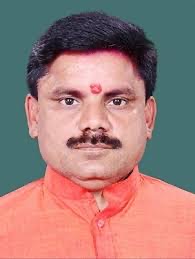
Archival portrait
An earlier official-style portrait, of the kind published in parliamentary member directories. The exact date is not documented. It is shown at its original, modest resolution rather than enlarged.
III · Education
Narkatiaganj and T.P. Verma College
The official profiles record his educational qualification as Intermediate, from T.P. Verma College, Narkatiaganj, West Champaran. Narkatiaganj is a sub-divisional town in the north of the district, on the rail line towards the Nepal border. In later years it became part of his political map. He represented the Narkatiaganj Assembly constituency from 2010 to 2014, and he raised the Narkatiaganj–Bhikhnathori railway line in the Rajya Sabha.
No year of completion or further study is stated in the current official profiles, so none is given here.
IV · Livelihood
An agriculturist by profession
Every official profile lists his profession as agriculturist. In West Champaran, the economy has long been tied to farming and to the sugar mills that process the district's cane.
Agrarian and rural issues appear repeatedly in his later parliamentary record. They include a starred question in the Rajya Sabha on the revival of closed sugar mills in Bihar in March 2021, a Special Mention on high-capacity dams to prevent recurrent floods in Bihar in September 2020, and a Special Mention on human–tiger conflict around the Valmiki Tiger Reserve in December 2022.
V · Toward public life
From the district to the Assembly
His official biography lists "Member, Executive Committee, Bihar, 2005". The record does not name the body or describe the position further.
His first elected office came in February 2005, at the age of 29. He won the Chanpatia Assembly seat in West Champaran as the Bharatiya Janata Party candidate, polling 27,642 votes according to the Election Commission's statistical report. That election returned a divided Assembly, and Bihar voted again in October–November 2005. He retained Chanpatia with 42,960 votes. The chronology from that point is set out on the Political Journey page.